
“Don’t Stand Behind a Horse”
Myth or truth?
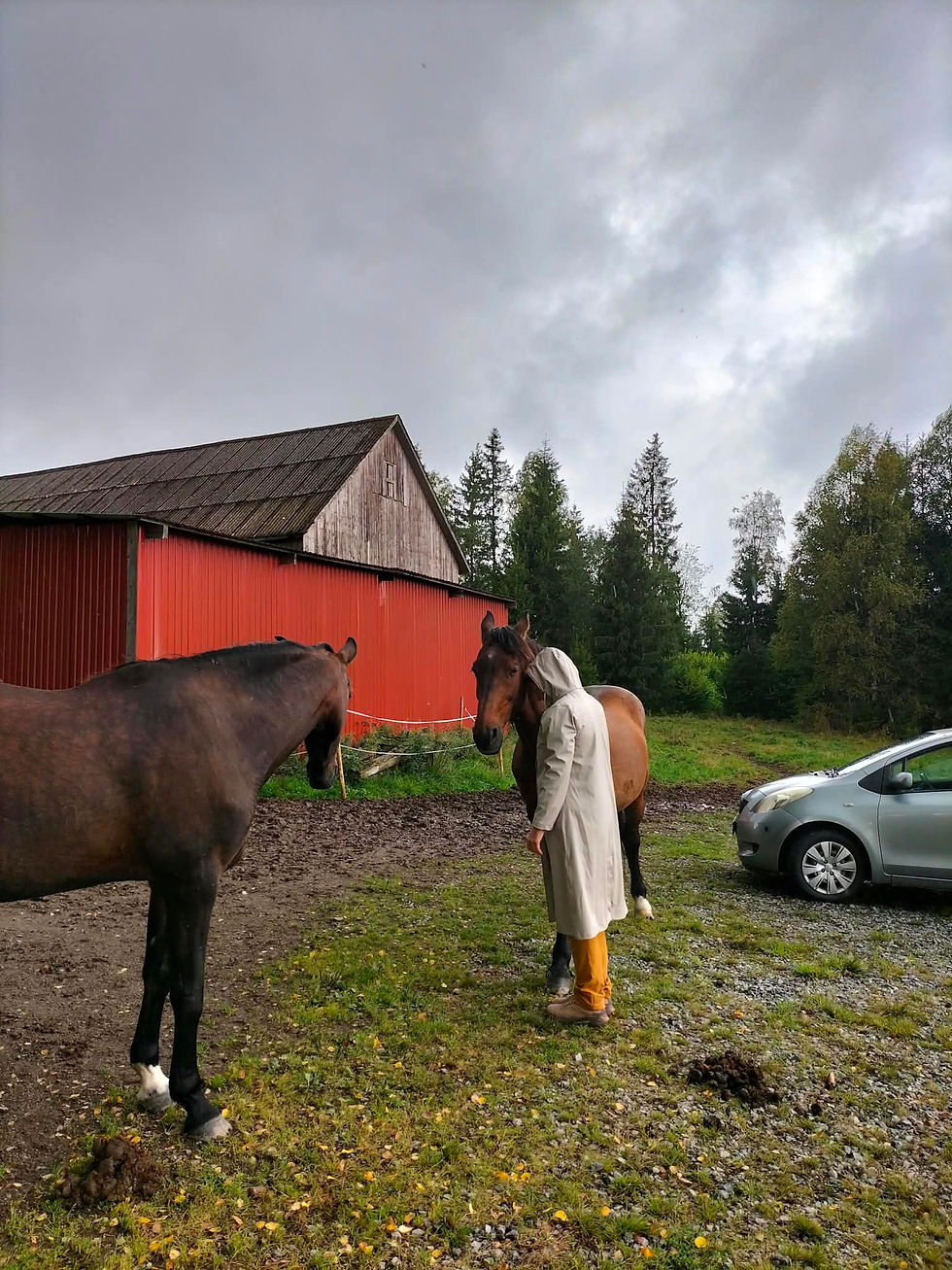
Yesterday, Boy walked over to a client who was sitting on her walker.
She is a horse person, comfortable around horses, grounded in herself and able to read him well. There was no fear in the interaction, only awareness and connection.
First, he approached gently with his nose, almost as though he was saying hello.
Then he turned around and carefully backed right in front of her, presenting his hindquarters directly towards her.
Not in aggression.
Not in dominance.
Not unpredictably.
He wanted a bum scratch.

And so she scratched him.
If you looked at the photo through a fear-based lens, you might see risk.
A woman sitting directly behind a horse.
A horse close to a vulnerable person.
Something potentially dangerous.
But that is not what I see when I look at this moment.
I see relationship.
I see a horse who approached softly, made contact, then communicated clearly what he wanted in the exact way horses often do with those they trust.
I see a woman deeply comfortable in the presence of horses.
I see nervous systems at ease with one another.
Horse people know this gesture well. Horses often position themselves this way with another horse, a human, or a companion they feel safe with. It is relational. Social. Vulnerable even.
What struck me afterwards was how differently the exact same moment could be interpreted depending on the lens someone brings.
One person might see: “A horse backing up towards someone — dangerous.”
Another sees: “A horse seeking connection.”
And that brought me back again to one of the most repeated phrases in the horse world:
“Don’t stand behind a horse.”
Most horse people have heard it. Many of us were taught it before we even learnt how to hold a lead rope.
It is often spoken as an absolute truth. A rule.A warning. A fear passed down through generations.
And yes — horses can kick. They are large animals with powerful hind legs. Respect matters.
But over time, I’ve become more interested in what sits underneath the statement.
Because when we reduce horses to danger, we stop becoming curious about relationship.
Horses Stand Behind Horses
In the paddock, horses move around each other constantly.
They graze nose to tail. Rest hip to hip. Walk behind one another. Young horses nap beside older horses with complete trust.
They do not live by the rigid human rule: “Never stand behind a horse.”
So perhaps the real conversation is not about position.
Perhaps it is about nervous systems.
The Real Risk Is Disconnection
Most horses do not kick “out of nowhere.”
Usually, there are whispers before the explosion: tightness, holding, hypervigilance, shutdown, discomfort, confusion, fear, pressure without release.
But many humans have been taught to override those whispers.
We approach horses carrying tension in our bodies.Agendas in our minds.Urgency in our movements.
Then we blame the horse for reacting.
Sometimes the horse’s kick is not aggression. It is communication.
Not “bad behaviour.”
Not dominance.
Not disrespect.
But an overwhelmed nervous system trying to create safety.
Trauma-Informed Means We Look Deeper
In trauma-informed work, we ask: “What happened to you?”rather than“What is wrong with you?”
I believe horses deserve the same curiosity.
A horse that kicks may have learnt humans are unpredictable. A horse may be in pain. A horse may feel trapped. A horse may have been punished for communicating softly and therefore learnt to communicate loudly.
And humans are no different.
Many people arrive around horses holding years of hypervigilance in their own bodies. They have been taught to override instinct. To perform calmness rather than actually feel safe.
Horses notice this immediately.
Not because they are magical.
But because they are honest.
Safety Matters — But So Does Relationship
This is not an argument for carelessness.
Boundaries matter.
Awareness matters.
Listening matters.
I still teach people how to move safely around horses.
I still pay attention to body language, tension, wind, herd dynamics, and environmental stress.
But I no longer want fear to be the primary lens through which we relate to horses.
Fear disconnects.
Attunement reconnects.
There is a profound difference between “Never stand behind a horse” and “Learn how to be in relationship with one.”
One creates avoidance. The other creates understanding.
The Horses Keep Teaching Me
The longer I do this work, the more I realise that horses are constantly inviting us into congruence.
To slow down.
To soften.
To become aware of what we are carrying.
Not to dominate them.
Not to control every outcome.
Not to demand obedience at the expense of connection.
But to become safer beings to be around.
For horses.
For ourselves.
For each other.
Perhaps the myth was never really about where we stand.
Perhaps it was about whether we know how to truly listen.


Comments