
A Trauma-Informed Arena: A Reflection on Horses, Humans, and Conditional Belonging
This is a reflection on how I work — and why.
Not as a method to be defended, but as a philosophy that has emerged slowly, quietly, through years of being with horses and humans in vulnerable places.
At Hurihanga, my work is grounded in trauma-informed practice. For me, that does not mean a checklist of techniques. It means an ongoing commitment to notice where power, control, and conditionality quietly enter relational spaces — and to choose differently when they do.
At the heart of my work is this belief:
No one should have to override themselves to belong.
Not the child.
Not the adult.
And not the horse.
Trauma and the subtle shape of conditional love
Much trauma does not come from single dramatic events. It forms through repeated experiences of conditional connection:
You are welcome when you behave
You are safe when you are manageable
You belong when you don’t make it hard for others
Most adults don’t consciously recognise how often this dynamic is repeated — because for many of us, it was normalised early. Control felt like care. Compliance felt like safety.
Trauma-informed work begins by recognising this pattern — and by refusing to recreate it in spaces meant for healing.

Why this matters so deeply when working with children
In my equine-assisted therapy work, I am very clear:
Sessions are not rewards.
Horses are not leverage.
Connection is not earned through behaviour.
A child’s access to the paddock does not depend on how regulated they are, how well they are coping, or whether they have met adult expectations that day. Many children already live in systems where love, attention, and safety are conditional.
The arena must not become another place where that message is reinforced.
A trauma-informed space says instead:
You can arrive exactly as you are.
Anger, shutdown, grief, resistance, joy — all are welcome.
Not because anything goes, but because safety must come before change.
Horses tell the truth about power
Horses are exquisitely sensitive to nervous systems and relational dynamics. They respond not to what we say we value, but to what we actually practise.
There is a growing movement in modern horsemanship that centres consent, emotional awareness, and ethical partnership. Practitioners such as Mustang Maddy and Lockie Phillips are part of this shift — moving away from dominance and force, and towards listening, feel, and respect for the horse’s experience.
In principle, we are aligned.
Where my work differs is not in values, but in focus.
Same principles, different orientation
Much modern horsemanship is horse-focused: supporting learning, agency, clarity, and emotional balance within a training relationship.
My work is human-focused, within a trauma context. The horse is not being trained. The horse is a relational partner and co-regulator.
When a third nervous system enters the field — particularly a child’s — the relational dynamics change. What supports learning in a training context may not support safety in a therapeutic one.
Context matters.
When reward enters the arena
I have spent time observing and reflecting on food-based reward systems and clicker training. In many contexts, food increases clarity and choice for horses, and I respect that.
In trauma-informed, human-centred work, however, I have repeatedly noticed something else.
Reward can unintentionally introduce a performance economy.
Presence can become negotiation. Connection can become something to earn. Engagement can slide into pleasing or compliance.
Some horses are not interested in food at all. Others engage — but in ways that feel attentive rather than free.
Trauma-informed practice is not interested in compliance. It is interested in safety.
Why I don’t take food into the paddock
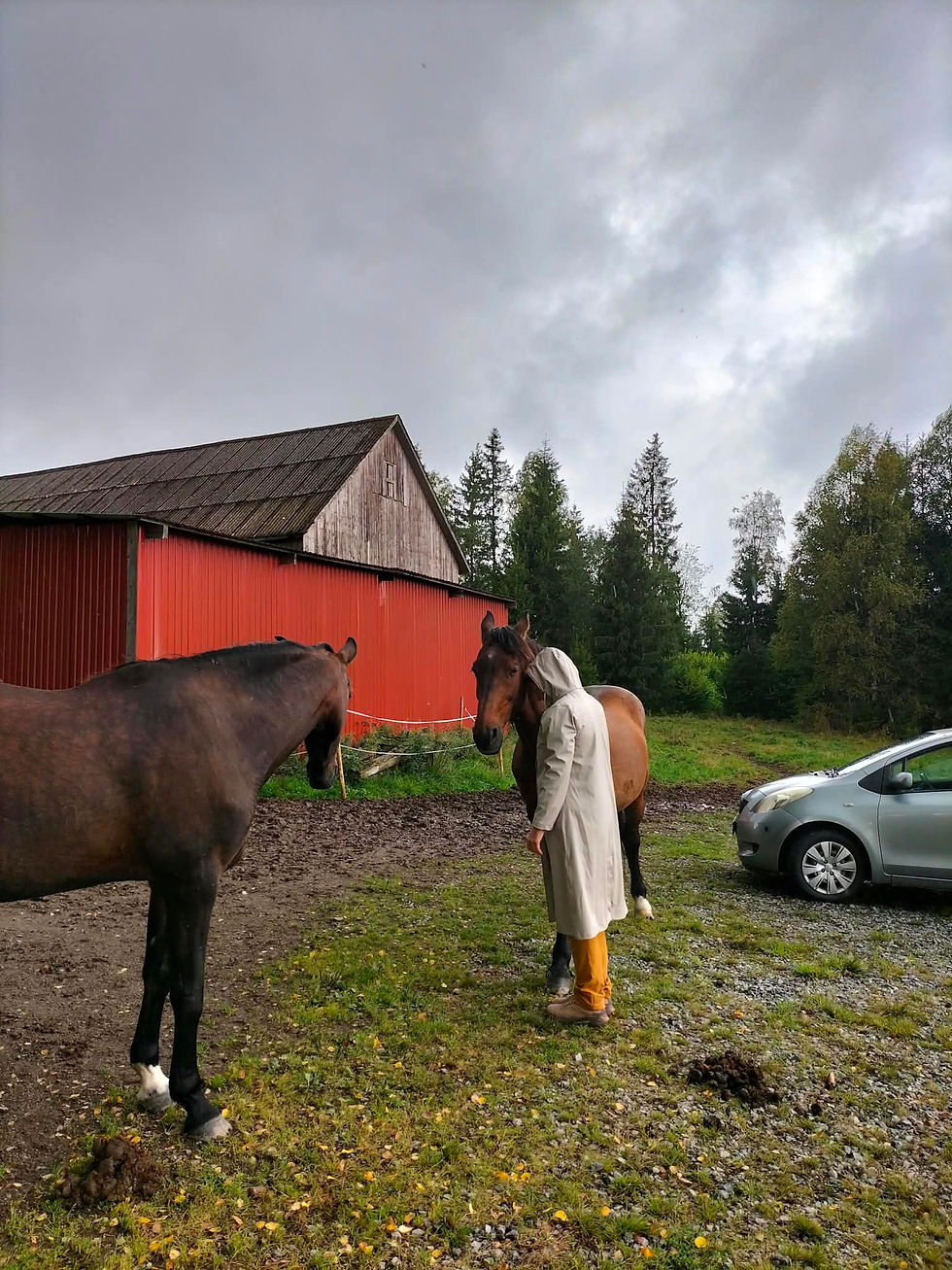
At Hurihanga, I do not take food into the paddock during therapy sessions.
This is not a judgement on reward-based training. It is a context-specific choice grounded in trauma-informed care. (And horses thinking that a human means food can become dangerous)
Without reward systems:
horses are free to approach, withdraw, observe, or disengage,
humans are not required to regulate in order to belong,
nothing is being earned or withheld.
The horse does not have to participate to be valued. The human does not have to perform to be welcome.
This creates a space of relational honesty.
Access is not the same as control
There are times when horses are brought into the arena.
This is usually because of access needs — for example, when someone has limited mobility, pain, fatigue, or physical constraints that make navigating paddocks unsafe or exhausting. In these moments, bringing the horses closer is about inclusion, not control.
The intention matters.
What I consciously work against is containment driven by expectation rather than need.
Requests to have horses haltered, held, or contained so that something is guaranteed to happen often come from anxiety, not entitlement. They make sense in a culture used to managing animals and outcomes.
But in a trauma-informed space, I pause here.
Because containment can quietly become control — and control changes the work.
When horses are contained for outcomes
When a horse is positioned to meet an expectation, the relational question subtly shifts:
What will the horse do for me? rather thanWho is the horse being with me?
In therapy, that distinction matters.
Horses are not props. They are not facilitators. They are not there to deliver an experience.
When they are free to choose — to approach, stay back, move away, or simply observe — they offer something far more honest than any guaranteed interaction.
They offer truth.
Expectations, riding, and reframing outcome
Many people arrive with understandable expectations:
that they will touch a horse,
that the horse will engage,
that something visible will happen,
or that riding may be part of the experience.
These expectations are cultural. They are not wrong — but they are often unexamined.
In my work, riding is not a default and often not part of the process at all.
Riding places the human physically and symbolically above the horse. It introduces skill, control, and performance, and can bypass the very relational dynamics that need attention.
Equine-assisted therapy at Hurihanga is not about doing something to a horse.
It is about being in relationship.
Sometimes that happens close.
Sometimes at a distance.
Sometimes in stillness.
Sometimes in watching and waiting.
All of it counts.
Allowing all emotions into the arena
The arena at Hurihanga is not a place to feel better.
It is a place to feel truthfully.
The horses do not require calm.
They do not demand coherence.
They do not ask for progress.
They respond to what is real.
When nothing is being rewarded or withdrawn, reality can surface safely — for horses and humans alike.
What I am really saying yes to
This work is not anti-training. It is trauma-informed care.
I am saying yes to:
safety before strategy
relationship before result
agency before outcome
presence over performance
And above all, I am saying yes to this:
Healing happens when no one has to earn their right to be here.
That includes the horses. That includes the children. And that includes the parts of us that learned, long ago, that love was conditional.
At Hurihanga, all emotions are welcome in the arena.

Comments