
Respecting the Boundary Is the Repair
Food for thought - As many of you know, I love the work of psychologist Bruce Perry. He created a model of Neurosequential Processing. Ie. How the brain processes information. It helps explain how we can jump in and out of relationship. One of the things I am most fascinated with helping my clients do is repair relationships without giving up their true self.
Today, one of the horses taught a client something about boundaries that I could probably have spent an entire counselling session trying to explain. And she did it in seconds.
Let's call my client Bernadette.

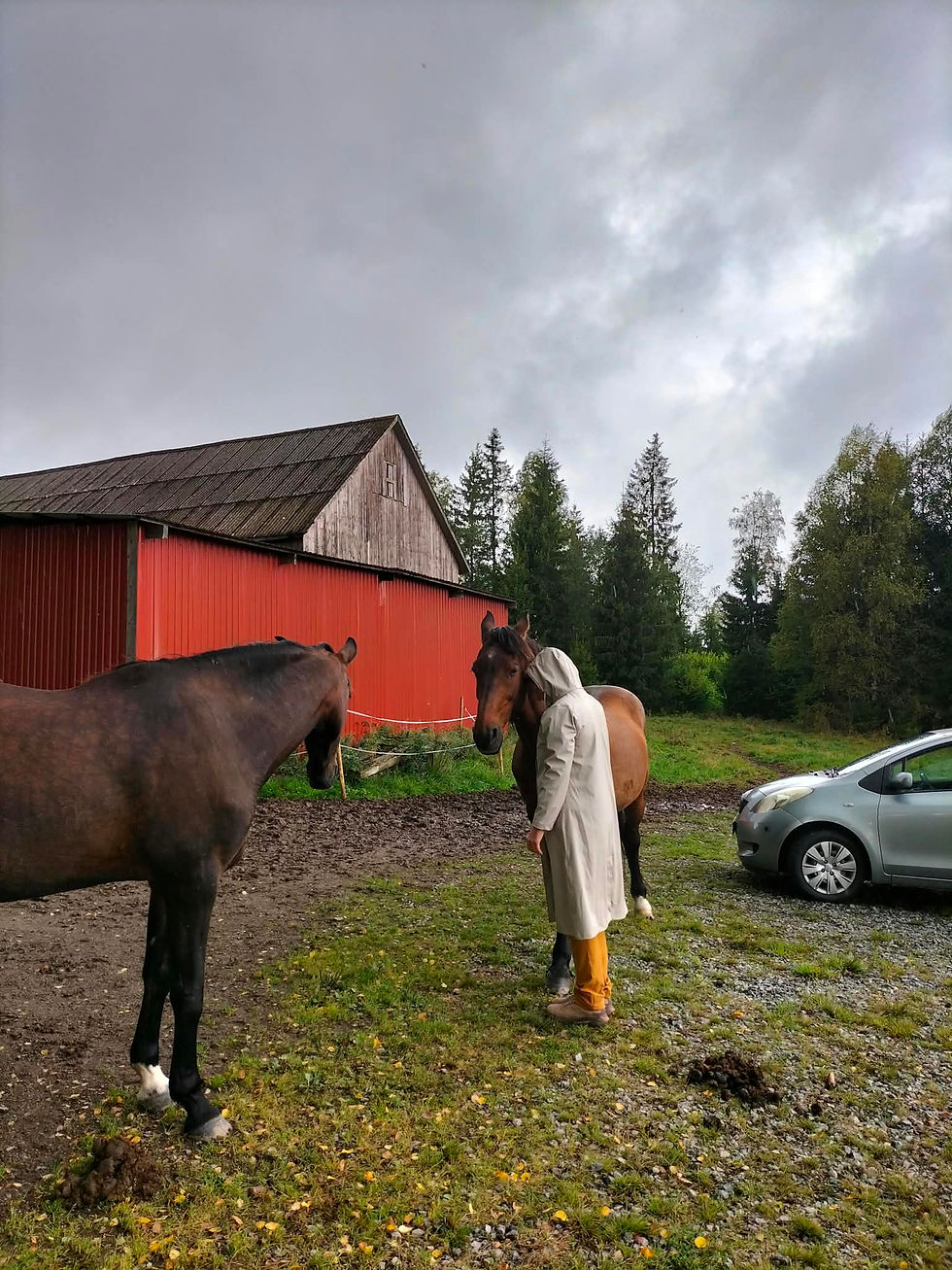
We were out in the paddock brushing Queenie. There was no formal equine exercise happening, we were simply together, brushing a horse, talking, being in relationship and allowing whatever arose to arise. Bernadette started telling me about the way she had been walking the other day and decided to demonstrate it. She was being silly and there was this playful, bigger energy to her walk.
She moved away from Queenie and in the general direction of Joy. She wasn't actually walking at Joy and Joy wasn't in her way, but Joy picked up on the change in her energy and proximity immediately and jumped out of the way. She was out of there.
Bernadette stopped and we talked about what had just happened. She was concerned that she had upset Joy and her immediate instinct was to go over to her, pat her and say sorry.
This is where it got interesting.
Bernadette herself doesn't particularly like being touched, so I reminded her of what Joy had actually just communicated. Joy hadn't stood there trying to tolerate something that felt uncomfortable. She hadn't waited for Bernadette to understand why she needed more space. She had simply registered that Bernadette and her energy were too close and moved herself away.
That was her boundary.
And once she had created the distance she needed, it was done.
Bernadette was like sorry Joy and went to go and pat her, but I explained that forgiveness wasn't really in Joy's vocabulary in that moment. That's the human story we put around what had happened. Joy wasn't standing on the other side of the paddock emotionally processing the incident or waiting for an apology. She had responded to what was happening in front of her, taken herself to where she needed to be, and carried on.
If Bernadette had followed Joy over to pat her and say sorry, she potentially would have crossed Joy's boundary again.
There is something so human in that. I know you've just asked me for space, but I need to come into your space so I can apologise for coming into your space!
We do this in relationships all the time. Someone tells us no, pulls away or asks for space and immediately we want to fix it. We want to explain our intention. We want them to know that we didn't mean to upset them. We want reassurance that they aren't angry with us, or we want to apologise and have that apology received so that we can feel okay again.
Sometimes an apology and relational repair are absolutely needed. But sometimes respecting the boundary is the repair.
I reminded Bernadette of something she already knew from working with the horses here. We don't walk up to them expecting they must accept our touch or attention. We step towards them and ask, and then we wait. The horse gets to decide whether they step towards us too.
She remembered this and was quite intrigued by what she had just learnt. Not because I had designed an exercise about boundaries, but because Joy had simply been Joy.
The nervous system knows before we have made a story about it
This is where I find Bruce Perry's Neurosequential approach particularly interesting. Perry talks about the way our brains process experience from the bottom up. Before we get to the clever thinking, explaining and meaning-making parts of ourselves, our nervous system has already been receiving information and responding to it.
It is often captured in the phrase regulate, relate, reason.
Joy gave us such a simple demonstration of this. Something changed in her environment. Her nervous system registered it and her body responded. She created the distance she needed and, once the situation had changed, she carried on.
Humans aren't always quite so good at the carrying-on bit.
We can feel that something isn't right and immediately override it. Don't be rude. Maybe I'm overreacting. They didn't mean it. What will they think of me? I should probably explain.
And we can do exactly the same thing when we are on the receiving end of someone else's boundary. But I didn't mean it that way. Let me explain. Are you angry with me? Can we talk about this?
Suddenly, that's close enough becomes an entire relational event.
There is something else here that I think matters. A boundary isn't necessarily a judgement about the other person. Joy wasn't telling Bernadette she was bad, wrong or unlikeable. She was communicating information about what worked for her in that particular moment: this is too close for me.
That is quite different.
Perhaps part of the difficulty humans have with boundaries is that we can experience them as rejection rather than information. If somebody moves away from us, says no or doesn't want what we are offering, we can immediately make meaning from it. Then instead of responding to the boundary itself, we respond to the story we have created about what the boundary means.
Joy didn't give us much room for a story. She just moved.
And none of this was planned
This might be my favourite part of what happened today. Bernadette didn't come for an equine exercise about boundaries. I hadn't arranged the horses in some clever therapeutic activity and Joy wasn't performing therapy for us.
We were brushing Queenie.
We were chatting.
Bernadette did a silly walk.
Joy moved.
And because we were paying attention to what was happening in the paddock, there was the work.
For me, this is some of the richest equine-assisted work. The horse gets to remain a horse. The client gets to be themselves. I don't have to manufacture a therapeutic moment or ask a horse to perform one. We can simply notice what happens when we are in relationship with another living being who has preferences, sensitivities and boundaries of their own.
Today Joy said, in the clearest way she knew how, that's close enough.
I read it, explained it to Bernadette.
And we worked out together how she could manage her need for repair without impinging on Joy (the horse's need for space)
That's the part worth taking out of the paddock with us. Sometimes a boundary doesn't need to become a battle or a rupture. We don't always have to make the other person understand our boundary, and when somebody gives us theirs, we don't necessarily have to explain our intentions until they understand us either.
It's tough, and requires the grit to check into our bodies. The interoception: awakening to what is happening to make us move!

Comments