
The Map Is Not the Herd
If there is something I truly love, it is being absorbed in thinking.
If someone presents me with a model—a map for understanding personality, leadership, relationships, or behaviour—I want to know how it works. I want to know what rules it is built upon and how it is being presented as different from what came before it.
Yes, I am that pedantic.
If you are interested, I can send you down several reading rabbit holes. And honestly, I would love nothing more than to send you there.
But underneath my fascination is a serious question:
What are the rules we are living by, and do they still take us where we want to go?
Be the Boss
There is an old saying in the horse world:
Be the boss.
The theory is that we must show the horse who is in charge. We give clear signals, insist that the horse follows them, and correct the horse when they do not.
This is often described as leadership. It may make our expectations clear, but what it primarily creates is obedience. Because the horse has no choice to say no. We will utilise coercive methods such as fear to make them do what we want.
As a counsellor, this is Behaviourism. (Skinner/Conditioning) Apply the cue, reinforce the desired response, correct what is unwanted, and shape the behaviour until the horse complies.
That can certainly produce a horse who performs what is asked.
But is that leadership?
Is it relationship?
Or have we simply become skilled at producing obedience?
And domestication.
The History Beneath “Be the Boss”
The power-over model did not begin in workplaces or horse arenas. It has been reinforced over centuries through monarchies, aristocracies and systems of land ownership.
Those who controlled the land and its resources had power over those who depended upon them. Kings, queens and landowners could demand labour, loyalty and obedience from people positioned beneath them.
Modern organisations inherited much of this structure.
We can still hear it in the language:
Superiors and subordinates. Chains of command. Rank and status. Moving up the hierarchy.
Authority sits at the top and flows downwards. The person above gives the instruction; the person below obeys.
The horse world has its own version:
Make the horse respect you. Don’t let him get away with that. Show him who is boss.
And often humans project this onto herd behaviour - who is the boss in the herd? But there is no boss in the herd, their will be behaviour that is circumstantial and different leaders emerge based on what is required moment by moment.
But positional power and leadership are not necessarily the same thing.
When Leadership Was Still a New Conversation
In the early 2000s, leadership still felt like a relatively new conversation in many workplaces. This was when I was fully emerged in corporate learning and development and most especially teaching sales (trading) and running leadership programmes.
People were only beginning to understand forms of management that were not based upon:
I am the manager. I hold the authority. I will tell you what to do, and you will do it.
Even Management by Objectives—introduced by Peter Drucker in 1954—was still not well understood. So many people thought that management was by instruction.
If you have been in corporate, you will have been exposed to targets, measures and KPIs. But they often missed the rest of Drucker’s idea: shared understanding, responsibility and self-direction.
The objectives remained something imposed from above.
By the time we were talking about Management by Values (an idea created by a corporate anthropologist), we were still trying to help people understand the difference between managing through positional authority and genuinely leading people.
Leadership did not mean becoming less clear, allowing chaos or pretending everybody had the same knowledge. It meant understanding what the group needed and responding accordingly.
Even older models such as Hersey and Blanchard’s Situational Leadership recognised that there was no single correct leadership style. Sometimes people needed clear direction.
Sometimes they needed teaching, encouragement or collaboration. As their competence and confidence grew, good leadership made increasing room for autonomy.
The purpose was not to preserve the leader’s position.
It was to help others develop.
Servant leadership took this further by asking whether the people being led became more capable, more autonomous, and more fully themselves.
So when someone tells me that leadership means being the boss, I become curious.
What definition of leadership are we using?
What paradigm are we defending?
And what happens to the horse within that paradigm?
Maps Are Useful—Until We Mistake Them for Identity
During my ten-day Empathic Interbeing course directed by the horses and communicated to us by Emelie Cajsdotter in Sweden, we were introduced to the concept of herd roles.
I love this concept.
I relate it to models such as ESCI, Belbin, DOPE, and the many four-quadrant personality profiles that have existed in various forms since the temperaments of sanguine, choleric, melancholic, and phlegmatic.
These maps can be useful. They help us recognise patterns in ourselves and understand why our communication works beautifully with one person and fails spectacularly with another.
The difficulty comes when people become attached to their type.
They stop using the model to understand relationship and begin using it to declare an identity:
This is who I am. The rest of the world will simply have to understand me.
But the value of knowing our style is not that everyone else must accommodate it. It is that we can recognise what happens between us and others.
A role only makes sense in relationship.
I see herd roles in a similar way. They offer humans another way of understanding horse behaviour.
The herd may include scouts, warners, defenders, risk assessors, caretakers, educators, peacemakers and healers. Different horses step forward according to their particular capacities and what the herd needs at that moment.
The scout extends awareness beyond the immediate herd. The defender responds when protection is needed. The caretaker notices vulnerability and stays near. The healer helps create the conditions in which healing can occur.
These are not necessarily fixed identities. They are relational contributions.
A horse may hold one role and then, through a particular meeting, step into another.
Leadership is not absent from this structure.
It moves.
The horse with the capacity required in that moment comes forward.
Does Boy (my horse) have KPIs?
If I want Boy to perform, then understanding who he is might help me understand why he is so spooky.
No, he does not have KPIs. Or does he?
Perhaps his performance has been measured all along:
Did he stand still? Did he move when asked? Did he remain calm? Did he obey the cue? Did he make me feel safe?
If obedience is the measure, then his awareness becomes a problem.
But what if Boy is a scout?
What if he notices what is beyond the immediate group? What if his sensitivity, vigilance, and responsiveness to the environment are not defects in his training, but part of what he contributes?
The map does not give me a final answer about Boy. But it changes the questions I ask.
Instead of asking, How do I stop him being this way?, I can ask:
What is he perceiving? What does this behaviour mean within the relationship? What becomes possible if I stop demanding that he abandon this part of himself?
When My Body Knew
In 2024, I was going to sell Boy.
I had become genuinely frightened of him.
I put shoes on him, loaded him onto the float, and took him to someone who had sold horses for people I knew. I was paying more than I could afford, believing this was what I needed to do.
As the weeks passed, Boy was being schooled into submission.
And I felt sick.
I began talking with friends who had sold horses through the same outfit. They told me a very different story from the one I had been relying upon.
Their honesty gave me the confidence to trust what I was already feeling.
This was not right.
It was not within integrity.
I heard a podcast about Emotion Codes and clearing intergenerational trauma. I wondered whether this might be part of what Boy and I were carrying—especially Boy. Could something be done for him rather than to him?
I went to see him on my way home. He was sad. He was not happy.
I promised him I would bring him home.
I told them I was taking him back. It was four weeks later (so a wee while)
There were many reasons to bring Boy home.
But mostly, it was my gut telling me that what was happening was not okay.
Perhaps I have wandered off track here.
Or perhaps this is the track.
Because this was not knowledge acquired from a model. It was the embodied experience of recognising that a system could produce obedience while violating relationship.
More recently, I learnt again what it meant to stand up for a horse—this time, my horse Joy. And she showed me in spades what that meant for her.... another pass at this learning.
These experiences change us.
We do not simply know something new.
We become unable to unknow what we have lived.
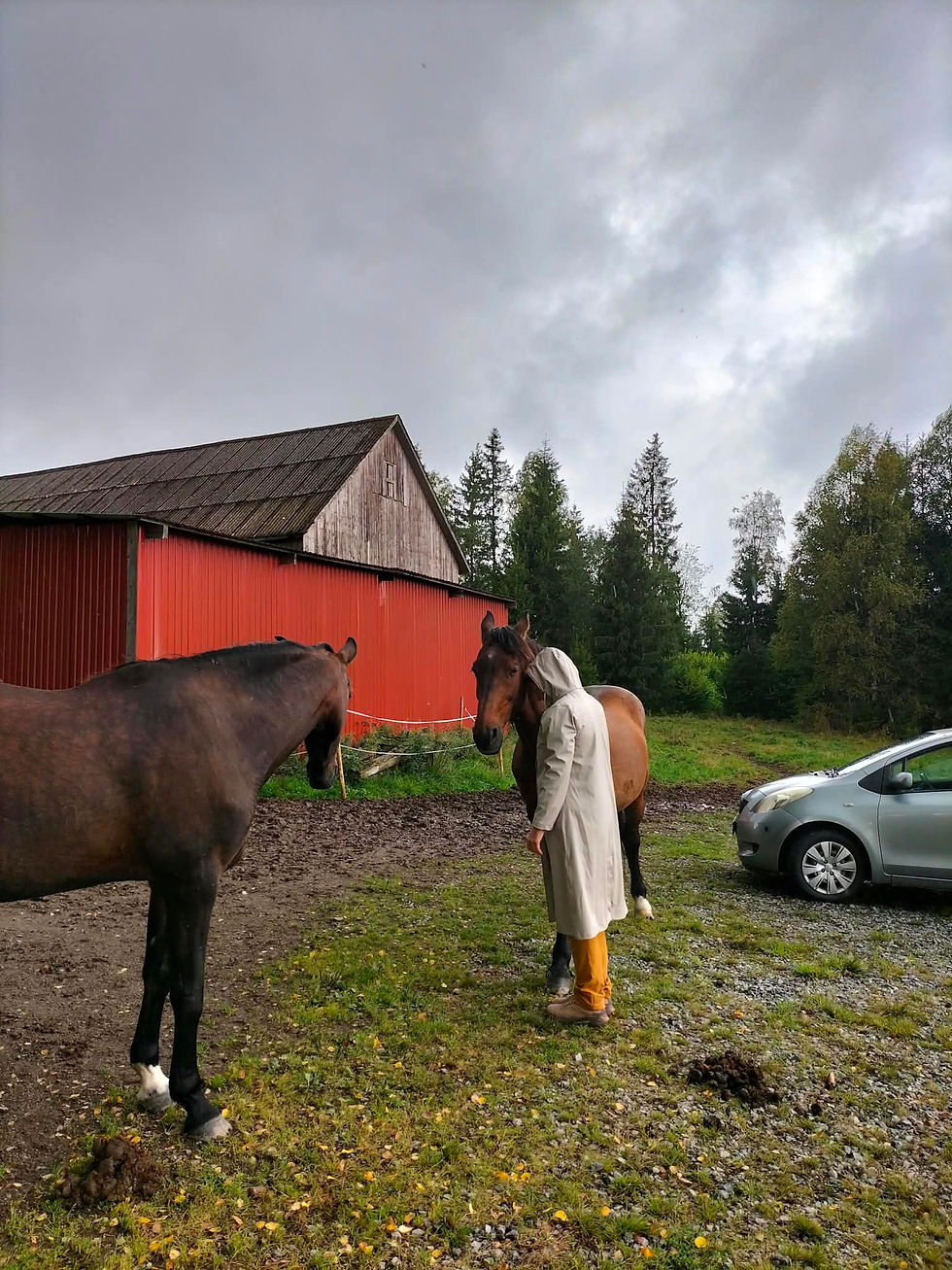
Mexico, Sprite and the Role That Emerged
At the end of the course in Sweden, each participant was told which horse would be their mentor.
Misty had invited me.
For a time, Amber appeared to be in the running.
Then Mexico and I met.
I stepped out to do the exercise that we were given in that moment. And I was wondering who I might do the exercise with. At that point Mexico beconned me over to him. And I chose him back. When I connected with him. Emelie was there and told me what he was saying. That he was pleased to connect with me as he has often done things alone and he would like to share this with me. He was supporting Sprite to heal. Often an abscess in a horse is due to them processing something for the herd.
He stepped forward and literally offered me his hoof.
Before Emelie named Mexico as my mentor, I had already thought that he was. This built my confidence to believe my gut feelings (my intuition)
Before our meeting, I believe Mexico had been expressing the role of caretaker.
But in the meeting between Mexico and me, something shifted.
He became a healer.
Not because somebody promoted him or awarded him a new title. Nor because he ceased being a caretaker.
A new capacity emerged within a new relationship. 1 +1 = 3
I was there to learn about Empathic Interbeing, and this learning will continue on through being mentored by Mexico after I leave Sweden.
Your Food Basket and Mine
There is a whakataukī that holds this beautifully:
Nāu te rourou, nāku te rourou, ka ora ai te iwi.With your food basket and my food basket, the people will thrive.
None of us needs to carry everything.
You bring what is yours to bring. I bring what is mine. The community is nourished through the presence of both.
I see this in the women’s circles within my community at home. Was enjoying my Saturday morning ritual at the market in Mangawhai... and always catch up with my friends there. Mel and I had a discussion about what I had learnt and I applied it to us.
When Mel teaches us pottery, she steps forward as a facilitator/Educator & Fosterer are the herd roles potentially.
She knows more about pottery than the rest of us. Acknowledging that does not create an oppressive hierarchy, nor does it require her to pretend that we all hold the same knowledge.
She leads.
She offers instruction, creates structure, and provides enough safety for us to begin.
But the purpose of her leadership is not to keep us dependent upon her expertise. It is to help us enter our own relationship with the clay.
Through the space she creates, one woman may rediscover play. Another may practise tolerating imperfection. Someone may find a creative voice she had silenced. Another may experience the pleasure of her hands knowing something before her mind does.
Mel brings her rourou: her knowledge of clay, form and process.
We bring ours: curiosity, imagination, vulnerability and willingness to try.
Her gift does not take up all the room.
It makes the room larger.
When the pottery session ends, Mel can release that particular role. At another gathering, someone else may carry the song, teach a craft, tend the fire, prepare the food, hold a boundary or notice who needs care.
Leadership moves towards the person whose capacity is needed.
Then it moves again.
But What Do We Mean by “The People”?
Another whakataukī is often quoted in leadership and organisational spaces:
He aha te mea nui o te ao? He tangata, he tangata, he tangata.
What is the most important thing in the world? It is people, it is people, it is people.
Through a Western lens, this can become another human-centred slogan: people are our greatest resource; people come first.
But people have also damaged the resources upon which all life depends.
When the final line is separated from the fuller imagery of the whakataukī, something vital is lost.
The kōrero begins with the harakeke:
Hutia te rito o te harakeke,kei hea te kōmako e kō?
If the central shoot of the harakeke is removed,where will the bellbird sing?
The answer about people is held within an image of an interdependent living system.
The rito, the surrounding shoots, the kōmako and the people are not isolated from one another. Remove the central shoot, and we do not lose only one part of a plant. We damage the structure that protects new life, interrupt regeneration, and take away the place from which the bird can sing.
The people are not placed above the ecosystem.
They are located within it.
Perhaps the meaning is not that humans are more important than every other form of life. Perhaps it is a reminder that people—and particularly future generations—must be protected within the relationships that make life possible.
The question is not simply whether people matter.
It is whether people remember what they belong to.
Holding Open the Space
Some experiences cannot be adequately explained by a model.
This is what happened for me in Sweden.
Someone can explain non-hierarchical thinking using a basic paradigm or an exchange-based situation, but many other forms of knowing are occurring in parallel.
We are not experiencing this universe in isolation.
There have always been forerunners who recognised that something was wrong within the system.
Do we blame patriarchy?
Do we blame colonisation?
Naming these systems is not about adopting a victim mentality. Sometimes we must say what something is not before we can find language for what it could become.
But knowledge alone is not enough.
We must embody what is needed to move forward.
So here I am, back in Aotearoa and back within my community, trying to explain something that may not be entirely explainable:
This thing I experienced in Sweden is about holding open a space in which you can be as alive as you can be.
A space in which you can live within your truth.
And perhaps it is my role within the herd to help hold that space open for you—not because I know who you should become, but because your aliveness makes the space wider.
And that is better for everyone.
That is leadership—but not leadership as power over.
It is leadership that protects the rito so the kōmako still has somewhere to sing.
It is leadership that brings its own food basket and welcomes the baskets carried by others.
It is leadership that does not ask Boy to abandon his awareness merely so that I can feel safe.
It is leadership that steps forward when its gifts are needed and steps back when another being’s capacity is called for.
It is leadership in service of life.
So thank you, Boy, for sending me on this journey.
Thank you for making it impossible for me to continue living by a map that could not recognise who you were.
And thank you to everyone who lets me be the complete nerd that I am while I keep trying to find words for something that, in its truest form, may have no words at all.


Comments