
When Calm Is Misread as Capacity
Horses, Nervous Systems, and the Cost of Performing Despite the Environment
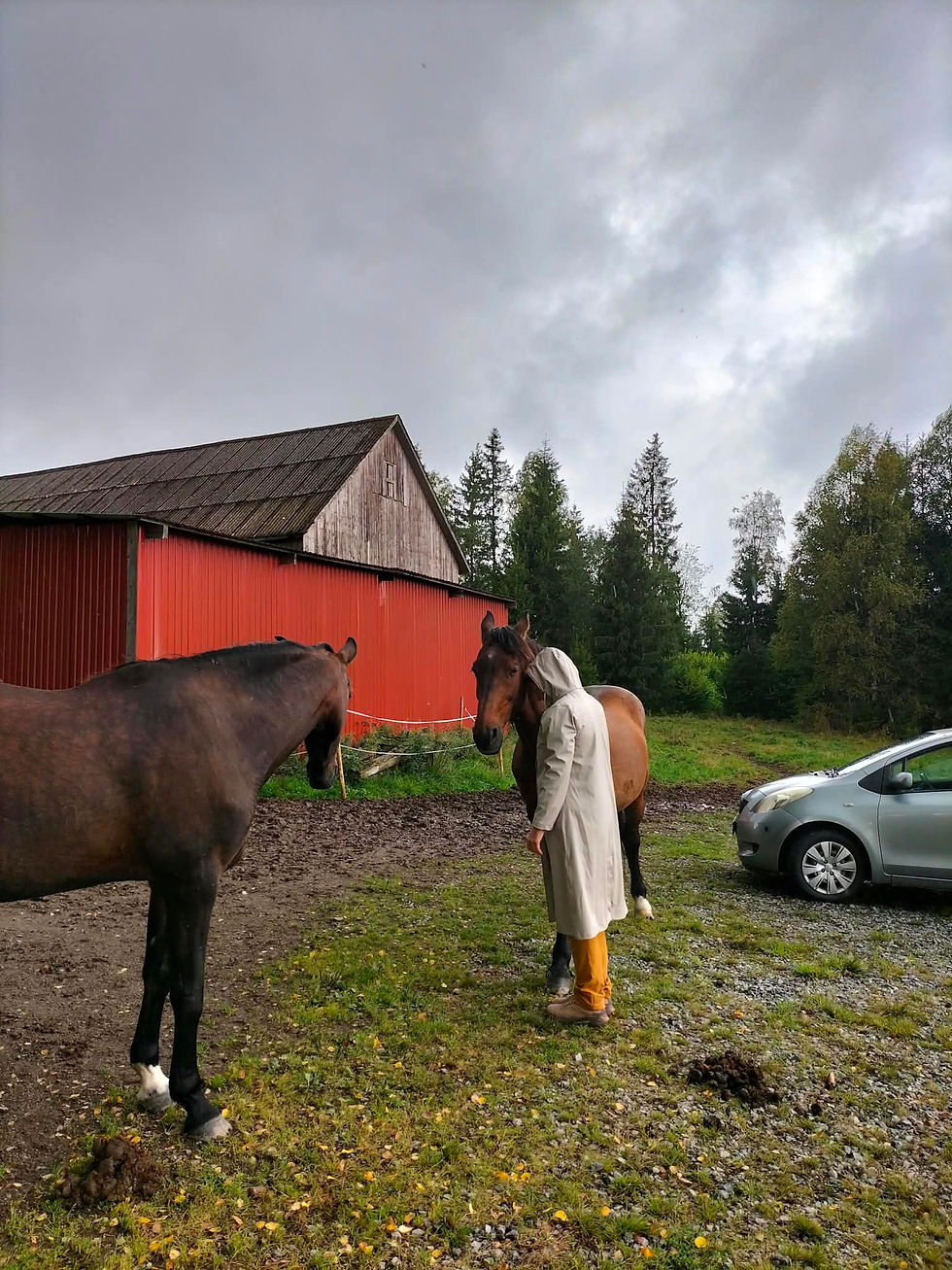
This past week, the weather has been relentless—wind, rain, pressure changes, and no real pause between systems. When I walked up to the paddock this morning, Boy was visibly agitated — running up and down, unsettled, unable to land.
Nothing “wrong” had happened. And yet everything had.
Horses, like humans, need more than micro-rests. They don’t just need to nod off while standing. They need to lie down. They need deep rest. They need REM sleep.

For prey animals, REM sleep only happens when the nervous system registers enough safety. And this week, with the conditions as they’ve been, that safety simply hasn’t been available.
Safety, Sleep, and the Nervous System
Stephen Porges’ Polyvagal Theory gives us a language for this. Rest, restoration, connection, and sleep are governed by the ventral vagal nervous system — the state in which the body feels safe enough to repair and restore.
Without that sense of safety, nervous systems default to vigilance or survival:
agitation, pacing, heightened alertness
or collapse without true restoration
Deb Dana reminds us that the nervous system is always scanning — through neuroception — for cues of safety or danger. This happens beneath conscious awareness.
Horses are exceptionally attuned to this. Prolonged wind, saturated ground, disrupted sleep, and unpredictable conditions all interfere with a horse’s ability to stand down.
What we saw this morning was not misbehaviour. It was a nervous system that hadn’t had a break.
When Calm Is Misread
One of the things that has always fascinated me is that I ride horses in a way where, to an observer, people often cannot see what I am riding.
They don’t see the sensitivity. They don’t see the reactivity. They don’t see the constant conversation I am in with the horse’s nervous system.
They see a calm horse.
And from that calm, a story can form: If the horse looks like that with her, I’ll be able to ride them too. They’ll cope.
But what is being missed is the relationship.
The calm is not accidental. It is not baseline temperament. It is not something the horse simply “is”. It is the result of years of attunement, timing, listening, and deep respect for environment and threshold.
When I ride, I am not riding behaviour. I am riding the state.
A regulated nervous system can look deceptively simple. When a horse feels safe, breathing slows, movement organises, and reactivity quietens. But that does not mean the sensitivity has gone away.
It means it is being held.
The Risk of Assuming Capacity
When calm is mistaken for capacity, horses are asked to cope rather than be supported.
They are ridden when the conditions are not right. They are expected to manage unfamiliar nervous systems. They are placed in environments where their sensitivity is exposed rather than contained.
When they respond — with tension, startle, or flight — it can be mislabelled as unpredictability or poor training.
In truth, it is often a break in relational safety.
This is something voices in the equine world, including Mustang Maddy and somatic practitioners, are naming more clearly now: movement and agitation are often attempts to discharge stress when rest and safety have not been available.
Running is not defiance.It is unfinished nervous system business.
Performance Culture and the Body
This mirrors what I see every day in my work with people.
Many clients have learned to perform despite the environment — to show up as expected, deliver outcomes, and override their internal signals in order to belong or be seen as capable.
Because they look calm, they are assumed to have capacity.
But calm on the outside does not always mean settled on the inside.
Just like the horses, much of what keeps people functioning is invisible regulation — effort that goes unnoticed, unacknowledged, and eventually exhausted.
Healing does not happen through invisible effort. Healing happens when effort is no longer required to feel safe.
Environment, Boundaries, and Professional Integrity
This week, a fellow therapist asked whether I could ride with her after all the weather events. I couldn’t promise the outcome she was hoping for. I couldn’t promise calm horses or a settled environment.
And that matters.
In trauma-informed, equine-assisted work, not promising an outcome is not avoidance — it is integrity.
She heard my concern about the wind, the conditions, and the horses’ nervous systems. She respected the boundary and said she would take my lead.
That moment mattered.
Because we all want to feel safe — and it is deeply regulating to be respected by someone who understands that safety is contextual, not theoretical.
Mātauranga, Place, and Trust
This is something I name clearly now.
I need to work with others who honour and respect my mātauranga and lived wisdom — with horses, within Te Arai, and within this environment.
Knowing when not to ride is as important as knowing how to ride. Knowing when conditions are not right is part of ethical practice. Knowing that safety cannot be forced is part of trauma-informed leadership.
At Hurihanga, the horses are not tools. They are not neutral .They are not endlessly available.
They are sensitive beings whose regulation depends on relationship, rest, and environment — just like ours.
This work asks for humility:
to listen rather than assume
to respect what cannot be seen
to honour calm without exploiting it
Because true safety — for horses and humans alike — is not about coping.
It is about being met.

Comments